I’ve been a successful freelance writer for about six years now so if only two people in the world know the answer to this question, I’m one of them.
Okay, that’s a bit of a stretch, but you get the gist – I am speaking from personal experience. Some of the tips I share may overlap but don’t worry, it’ll all make sense in the end.
So whether you're just starting your freelance writing career or trying to scale it, I've got you.
How do freelance writers get clients?
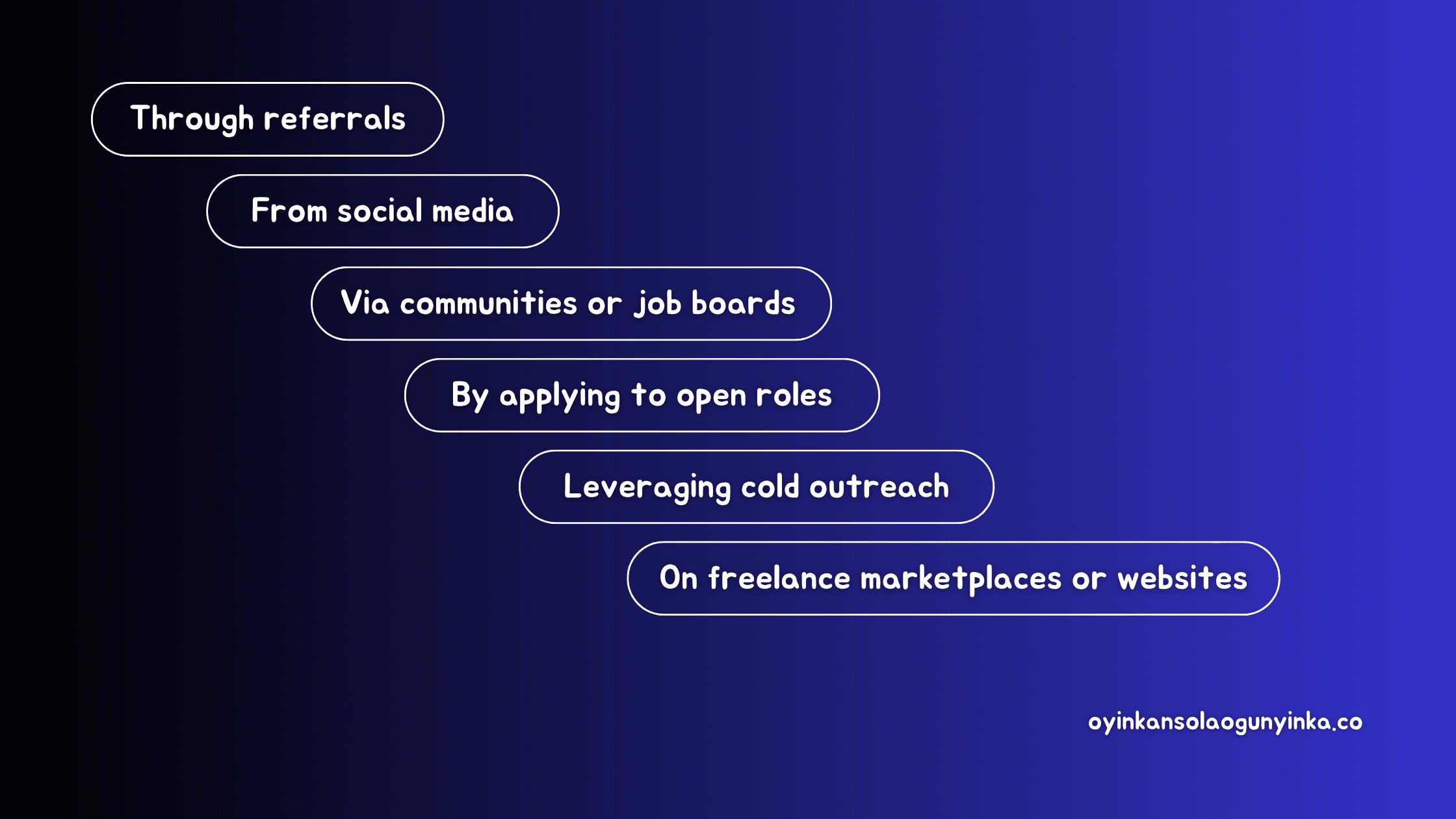
Here are six proven ways to find freelance writing jobs:
Through referrals
From social media
Via communities or job boards
By applying to open roles, anywhere
Leveraging cold outreach
On freelance marketplaces or websites
1. Through referrals
Many potential clients reach out because someone recommended me to them. I get freelance writing job recommendations because I’m vocal about the work I do and don’t hesitate to let people in my network know when I’m looking for work.
How to stay get referrals
Stay top-of-mind for people who can send work your way with the following steps.
Tell friends and past colleagues you’re looking for freelance writing work and let them know the specific niche you want.
Post about being open to work on LinkedIn or Twitter and add your freelance writing expertise to your bio.
Add the #opentowork banner to your LinkedIn page and updating your profile with your most recent work experience.
2. From social media
I mentioned LinkedIn and Twitter already in the first point. But asides those, Instagram and WhatsApp are also hidden gold mines for attracting your dream clients.
In fact, few days after I closed a new client who reached out to me on LinkedIn, another prospect contacted me via Instagram DMs. I didn’t accept the offer because it didn’t match my requirements, but I was happy that sharing my writing expertise on my social media accounts was paying off.
How to find clients on social media
Mention your writing services in your bio (and about sections).
Post about your services and past experiences occassionally, without being too salesy.
Follow potential recruiters and engage with their posts to boost your visibility.
Connect with people working at your dream companies and build a rapport with them.
Message previous employers or other writers to see if they have or know of any freelance writing opportunities.
3. Via communities or job boards
Personally, I am a member of top content marketing communities like Superpath, Peak Freelance, The H Spot Writers Community, and the FCDC (Freelance Coalition for Developing Countries). Niche Facebook Groups for writers might also be worth exploring
I recently closed a high-paying client by applying to a gig posted in the freelance channel of one of these communities. And while I haven’t closed that many freelance clients from this channel, I have gotten access to top content leaders and had promising interviews and chats.
4. By applying to open roles, anywhere
You don't build a sustainable freelance writing career by simply being the best writer in the room. You build it by doing the hard work of understanding the types of clients and projects that align with your skills and interests, and applying to them.
Will you get every gig you apply for? Probably not. But the ones you get can go a really long way. That's why if I see an interesting freelance writing vacancy, I apply as soon as possible.
Ways to get an interview and win the client
Connect with the recruiter on LinkedIn, engage with their posts, and (possibly) send them a direct message about your application.
Reach out to your connections or people in your network who work at the company to ask about the company culture and see if they can help track/push your application in-house.
Create and share a website and/or portfolio link where prospects can easily view and assess your work experience and sample blogs. And remember: Update your portfolio with new samples every 6 to 12 months to demonstrate current activity.
Send an email to the recruiter, hiring manager, or a C-level executive at the company, telling them about your application, and sharing your experience and portfolio – plus reasons why you’re a great fit for the role.
5. Leveraging cold outreach
I recently started experimenting with cold outreach, but only on LinkedIn for now. The result? I've gotten some replies and secured one guest post with this approach.
Want to give it a try? Use this cold LinkedIn DM template I created (yes, it's the one I used to secure the guest post and you can tweak it for cold emails).
What to do before starting the outreach process
Focus on brands with existing content teams or those already working with freelance writers as they already know the value of your work.
Don't make the mistake of using my template word for word. Adjust it to match your personal goals, industry, and writing rates.
Prepare 2 to 3 writing samples to add to the message or send over when you get a response.
Be confident, as this is crucial when pitching to clients and negotiating rates.
You're welcome!
6. On freelance marketplaces or websites
As with cold outreach and pitching, I have had little success with freelance marketplaces and sites. Some successful freelance writers would beg to differ though so don’t limit yourself.
Some top freelance marketplaces and websites
Upwork
Fiverr
FlexJobs
Freelancer.com
Build a successful freelance career
If you're a new writer considering freelancing or an existing freelancer trying to scale, the practical tips I just shared will help you on your way.
The major challenge would be around closing your first few clients, retaining them, and operating as an independent contractor (sometimes without the security of a full time job).
As someone who's been in the freelance writing world for over 5 years, I can help you figure things out. Book a mentorship session today and let's discuss scaling and future-proofing your freelance business.
Other things to note about getting clients as a freelance writer
Need some more tips? Here's some of my best advice.
Start with a niche and build around it. When seeking your next or first client, specializing helps you stand out and attract better-paying work.
Grow visibility before outreach. Create consistent content, write guest posts, and start building a personal brand that signals credibility.
Warm up your prospects first. Follow potential clients (e.g., on LinkedIn), engage with their content, and start conversations before pitching.
Make your pitch clear and easy to act on. State that you’re a freelance writer, highlight your niches, link your portfolio, and show how you can solve their problem.
Network in two directions. Connect with potential clients for writing gigs and other freelance writers for referrals and industry or company insight.
Do great work to unlock referrals and long-term contracts. Strong delivery leads to repeat business, referrals, and retainer-style work, which provide stability in freelancing.
Use a structured onboarding process. Implementing a professional onboarding process helps set expectations, build trust, and prevent scope or payment issues.
Avoid low-paying content mills. They often pay as low as $0.03/word and can stall your growth long-term.
Price with context, not guesswork. Rates vary by niche, client, and location, so benchmark through research and conversations with other freelancers.
Set a non-negotiable minimum rate. Know the lowest you’ll go to protect your standards and sustainability.
Choose a pricing model that fits the work. Per word, per project, or hourly—pick what aligns with your services and clients.
Use market benchmarks to guide you. Ask fellow freelancers for guidance or lean on communities for support. For example, groups like Superpath don’t allow jobs below $0.10/word, which can serve as a useful quality baseline.
Expect wide variation in beginner earnings. What you make early on depends heavily on your niche, clients, and positioning—not just experience level.
Work with a mentor that can give you expert guidance. E.g., me. Get started here.